
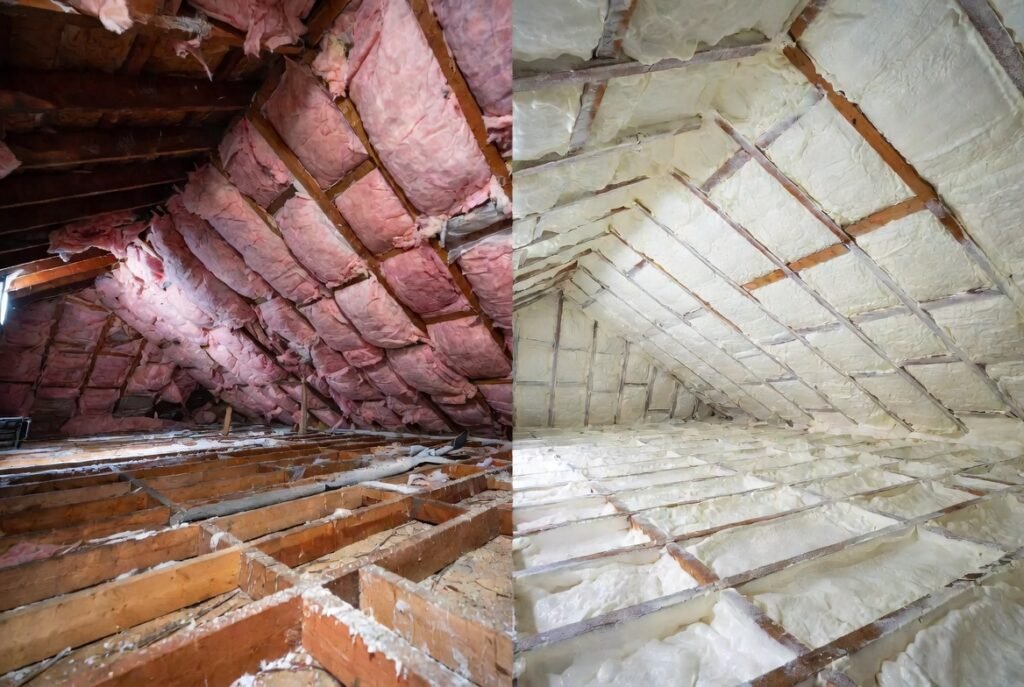
Spray Foam vs. Fiberglass Insulation: Best Choice for Ottawa Homes
Ottawa homeowners face some of the toughest weather conditions in Canada—freezing winters with wind chills below -30°C, humid summers, and increasingly unpredictable storms. Your home’s insulation plays a critical role in maintaining comfort, controlling energy costs, and protecting the structure from moisture damage.
The most common question we hear at Bison Insulation is, “Should I choose spray foam or fiberglass?” While fiberglass has been the go-to for decades and remains popular due to lower upfront cost, modern building science clearly shows spray foam insulation in Ottawa outperforms fiberglass in nearly every performance category that matters in our climate.
In this detailed comparison, we’ll break down the key differences, backed by real-world performance data, so you can make an informed decision for your home.
Fundamental Differences: How Each Material Works
Fiberglass Insulation
Fiberglass (often seen as pink batts or yellow loose-fill) is made from spun glass fibers that trap pockets of still air. Its insulating power comes entirely from slowing conductive heat transfer through those air pockets.
- Porous by design
- Does not stop air movement
- Relies on perfect installation and a separate air/vapor barrier for full performance
Spray Polyurethane Foam (SPF)
Spray foam is a two-component chemical mixture applied as a liquid that expands 30–100 times in seconds, hardening into a solid plastic foam.
- Closed-cell foam: Dense, rigid, high R-value, acts as air + vapor barrier
- Open-cell foam: Softer, lower density, excellent for sound control
The expansion allows it to fill every gap, crack, and irregularity, creating a seamless, monolithic layer.
R-Value Comparison: Lab vs. Real-World Performance
Rated R-Value
- Fiberglass batts: R-3.0 to R-3.8 per inch
- Blown-in fiberglass/cellulose: Similar range
- Closed-cell spray foam: R-6.0 to R-7.0 per inch
- Open-cell spray foam: R-3.6 to R-3.8 per inch
At first glance, open-cell foam seems comparable to fiberglass. However, the real difference emerges in effective performance.
Real-World R-Value Degradation
Fiberglass loses significant effectiveness when exposed to air movement (convection). Studies from Building Science Corporation and Oak Ridge National Laboratory show that air leakage through and around fiberglass can reduce its effective R-value by 30–50%.
Spray foam maintains its full rated R-value because it eliminates convection entirely. In Ottawa’s Zone 6/7 climate, where code requires R-60 for attics, you need approximately 18–20 inches of fiberglass—but only 9–10 inches of closed-cell spray foam.
This space-saving advantage is crucial for retrofits with limited cavity depth, such as older homes in Centretown, the Glebe, or Westboro.
Air Sealing: The Biggest Performance Gap
Ottawa’s windy conditions make air infiltration one of the largest sources of heat loss.
Fiberglass: Acts Like a Filter
Fiberglass slows air but does not stop it. Hidden gaps around wiring, plumbing, top plates, and rim joists allow cold air to bypass the insulation entirely. This “wind-washing” effect dramatically reduces performance and creates uncomfortable drafts.
Spray Foam: True Air Barrier
Spray foam adheres to all surfaces and expands into every void, creating a continuous air barrier. Independent testing shows spray foam homes can achieve air leakage rates 5–10 times lower than code minimum.
The result? Dramatically reduced drafts, more even temperatures, and lower heating bills—often 30–50% savings compared to fiberglass-insulated homes.
Moisture Management and Mold Prevention
Ottawa’s high humidity swings create serious moisture risks in building assemblies.
Fiberglass Vulnerability
Fiberglass is hydrophilic—it wicks and holds moisture. When warm, moist interior air reaches cold surfaces through leaks, condensation forms inside the insulation. Wet fiberglass loses R-value and becomes an ideal mold growth medium.
Spray Foam Advantage
- Closed-cell foam is a Class II vapor barrier (perm rating ~0.8) and does not absorb water
- Prevents condensation by stopping warm air from reaching cold surfaces
- Inorganic and mold-resistant (does not provide food source)
In basements, crawl spaces, and cathedral ceilings—common problem areas in Ottawa homes—closed-cell spray foam virtually eliminates moisture-related issues. If existing mold is present, professional remediation is essential first; see our mold removal services in Ottawa.
Soundproofing Capabilities
Living near busy roads like the Queensway, Carling Avenue, or the O-Train? Noise is a frequent complaint.
Fiberglass offers minimal sound blocking due to its low density. Closed-cell spray foam, with its high mass and airtight seal, provides superior acoustic performance—often reducing exterior noise by 10–15 dB, making homes noticeably quieter.
Long-Term Durability and Settling
Fiberglass Issues
- Settles and sags over time (especially blown-in)
- Compresses around obstacles
- Fibers can break down and release particles
- Vulnerable to pest nesting and damage
Spray Foam Stability
- Does not settle, sag, or degrade
- Adheres permanently to substrates
- Deters rodents and insects (no nesting material)
- Closed-cell adds structural strength (up to 3x racking resistance)
Cost Comparison: Upfront vs. Lifetime Value
Fiberglass has a lower initial material cost—often 40–60% less than spray foam. However, factor in:
- Higher energy bills year after year
- Potential moisture damage repairs
- Shorter lifespan requiring eventual replacement
- Reduced comfort and resale value
Spray foam typically pays for itself in energy savings within 5–8 years and continues delivering benefits for decades. Many homeowners also qualify for greening rebates that offset upfront costs.
Best Applications for Each Material
When Fiberglass Makes Sense
- Large, open attic spaces with easy access
- Budget-constrained projects where air sealing is addressed separately
- New construction with perfect detailing
For cost-effective attic top-ups, consider our blown-in insulation in Ottawa.
When Spray Foam is Clearly Superior
- Retrofits with limited space
- Older homes with air leakage issues
- Basements, crawl spaces, and rim joists
- Cathedral ceilings and flat roofs
- High-performance or net-zero builds
- Homes prioritizing comfort, health, and energy efficiency
Explore our comprehensive spray foam insulation services in Ottawa.
Specific Ottawa Home Applications
Attic Insulation
The #1 upgrade for most homes. Spray foam on the roof deck creates a conditioned attic, eliminating ice dams and heat loss. Learn more about professional attic insulation in Ottawa.
Floor and Crawl Space Insulation
Cold floors over unheated spaces are common complaints. Spray foam seals and insulates rim joists and floors from below, warming living areas. See our targeted floor insulation solutions in Ottawa.
Insulation Removal for Upgrades
Old, settled, or contaminated fiberglass often needs removal before spray foam application. Safe, professional insulation removal in Ottawa ensures optimal results.
Conclusion: The Clear Winner for Ottawa’s Climate
While fiberglass remains a viable option for certain applications, spray foam insulation delivers superior performance in air sealing, moisture control, long-term R-value stability, comfort, and energy savings—exactly what Ottawa homeowners need most.
The investment in professional spray foam installation pays dividends for decades in lower bills, healthier indoor air, and a more comfortable home year-round.
Ready to upgrade your Ottawa home? Contact Bison Insulation for a free evaluation. Visit our homepage to explore all our services and schedule your consultation today.